This site uses third-party website tracking technologies to provide and continually improve our services, and to display advertisements according to users' interests. I agree and may revoke or change my consent at any time with effect for the future.
This site uses third-party website tracking technologies to provide and continually improve our services, and to display advertisements according to users' interests. I agree and may revoke or change my consent at any time with effect for the future.
Managing identities across dozens, or even hundreds, of client environments is one of the most complex challenges MSPs face today. Every new client brings a unique tech stack, different compliance requirements, and varying levels of security maturity. Without the right identity management infrastructure, you're left juggling multiple admin consoles, manually provisioning users, and reacting to security incidents instead of preventing them.
The stakes are high, with 1.8 billion credentials compromised in early 2025, a single compromised credential can expose your entire client base to risk, damage your reputation, and trigger costly breach notifications. Yet many MSPs still rely on patchwork solutions that weren't designed for multi-tenant environments, leading to inefficiencies that eat into margins and slow down service delivery.
This guide explores the top 11 MSP identity management software solutions for 2026, evaluating each platform's multi-tenant capabilities, integration ecosystem, and security features. Whether you're managing 10 clients or 500, you'll find practical insights to help you choose a solution that scales with your business while keeping your clients secure.
How to Choose the Right Identity Management Software for Your MSP
Choosing identity management software isn't about finding the tool with the most features, it's about finding the right fit for your specific MSP business model and client base. Start by evaluating your current client portfolio. Are you primarily supporting small businesses with basic needs, or do you manage enterprise clients with complex compliance requirements? The answer should guide your platform selection.
Consider your team's technical capabilities. Some platforms require significant expertise to configure and maintain, while others offer more turnkey experiences. If you're a smaller MSP without dedicated security specialists, a platform that requires extensive custom scripting and API work may slow you down rather than speed you up.
Pricing models vary dramatically across platforms. Some charge per user, others per client organization, and some offer flat-rate MSP licensing. Run the numbers across different client scenarios to understand your true costs. A platform that seems affordable for your current client base might become prohibitively expensive as you grow, or vice versa.
Don't underestimate the importance of vendor support. When you're managing identities for dozens of clients, you need responsive support that understands MSP workflows. Look for vendors with dedicated MSP programs, not just enterprise sales teams that happen to work with service providers. The quality of documentation, community resources, and technical support can make or break your experience with a platform.
Finally, test the multi-tenant experience yourself. Most vendors offer trials or demos. Set up a few test client environments and walk through common workflows, provisioning a user, investigating an access issue, generating a compliance report. The platform that looks great in a sales presentation might feel clunky in daily use. Trust your hands-on experience over marketing materials.
Josys Multi-tenant Platform
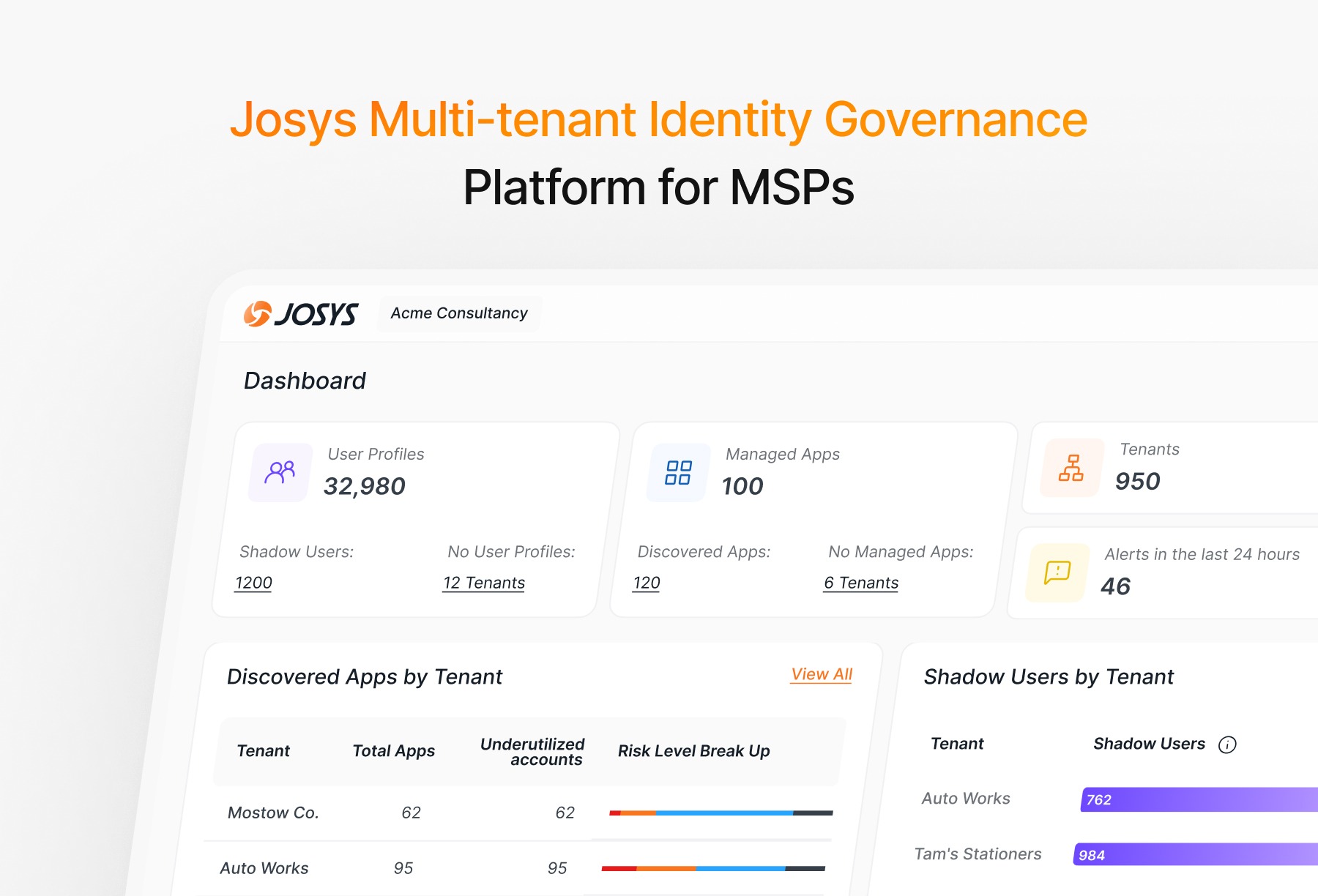
Josys stands out as a comprehensive identity governanceplatform designed specifically for IT teams managing multiple clients. Unlike traditional IAM tools that bolt on multi-tenancy as an afterthought, Josys was built from the ground up to handle complex, multi-client environments.
The platform consolidates user provisioning, license management, and access control into a single pane of glass. You can onboard new employees across all their SaaS applications in minutes, automatically assign the right access based on role policies, and deprovision users instantly when they leave, all while maintaining complete separation between client environments.
What sets Josys apart is its intelligent automation engine. The platform learns from your provisioning patterns, suggests optimizations, flags unused licenses that drain client budgets, and alerts you to access anomalies before they become security incidents. For MSPs tired of manually tracking who has access to what across dozens of clients, Josys delivers the visibility and control you need without adding administrative overhead.
Okta MSP Edition
Okta provides robust single sign-on (SSO) and multi-factor authentication (MFA) capabilities with MSP support. The platform excels at integrating with thousands of pre-built connectors, making it relatively painless to add new applications to your clients' identity infrastructure.
The MSP dashboard allows you to monitor authentication events, configure policies, and manage users across all client organizations from a centralized console. However, the pricing structure can become expensive as you scale, particularly for smaller MSP clients who may balk at per-user costs.
Microsoft Entra ID (formerly Azure AD) for MSPs
For MSPs heavily invested in the Microsoft ecosystem, Entra ID offers deep integration with Microsoft 365, Azure services, and Windows environments. The platform provides conditional access policies, identity protection, and privileged identity management capabilities that work seamlessly with Microsoft's security stack.
The challenge? Managing Entra ID across multiple tenants requires careful architecture planning. You'll need to leverage Azure Lighthouse for cross-tenant management, and the learning curve can be steep for teams without extensive Azure experience. That said, if your clients are already Microsoft-centric, the integration benefits often outweigh the complexity.
JumpCloud for Managed Service Providers
JumpCloud positions itself as a cloud directory platform that combines identity management, device management, and access control. For MSPs managing hybrid environments with both cloud and on-premises resources, JumpCloud offers a unified approach to authentication across Windows, Mac, and Linux systems.
The MSP portal provides multi-tenant management with role-based access control, allowing your technicians to support clients without needing separate credentials for each environment. The platform's RADIUS and LDAP capabilities make it particularly useful for clients transitioning away from on-premises Active Directory.
OneLogin MSP Platform
OneLogin delivers enterprise-grade SSO and MFA with a focus on user experience. The MSP program includes white-labeling options, allowing you to brand the authentication experience for your clients. The platform's Smart Hooks feature enables custom workflows and integrations beyond the standard connector library.
OneLogin's strength lies in its policy-based access controls, which let you define granular rules based on user attributes, device posture, location, and risk level. However, some MSPs report that the multi-tenant switching experience could be more streamlined compared to purpose-built MSP platforms.
ManageEngine AD360 MSP
ManageEngine AD360 is a comprehensive identity and access management suite that includes Active Directory management, privileged access management, and identity governance. For MSPs supporting clients with hybrid environments, AD360 provides tools to manage both on-premises AD and cloud identities from a single console.
The platform's strength is its depth of AD-specific features, automated AD cleanup, group policy management, and detailed audit reports. The trade-off is complexity; AD360 has a steeper learning curve than cloud-native alternatives and may be overkill for clients who have fully migrated to cloud infrastructure.
Duo Security MSP Program
Duo, now part of Cisco, specializes in multi-factor authentication and device trust. The MSP program provides centralized management for deploying MFA across client environments with minimal friction. Duo's approach to authentication is user-friendly, push notifications, biometrics, and hardware tokens, making adoption easier for non-technical end users.
While Duo excels at MFA, it's not a full identity management platform. You'll need to pair it with other tools for user provisioning, SSO, and lifecycle management. That said, if your primary goal is adding a layer of authentication security across all client environments, Duo delivers reliable protection with straightforward deployment.
CyberArk Identity for MSPs
CyberArk brings enterprise-grade privileged access management to the MSP market. If your clients handle sensitive data or operate in regulated industries, CyberArk's focus on securing privileged accounts and credentials may be exactly what you need. The platform provides session recording, just-in-time access provisioning, and anomaly detection for high-risk accounts.
The downside? CyberArk is positioned at the premium end of the market. Smaller MSP clients may find the feature set exceeds their requirements and budget. However, for clients in healthcare, finance, or government sectors, the investment in robust privileged access controls often pays for itself in avoided compliance violations.
Auth0 MSP Partner Solution
Auth0, also part of Okta's portfolio, focuses on customer identity and access management (CIAM). For MSPs supporting clients with customer-facing applications, Auth0 provides the authentication infrastructure to secure login experiences, manage customer identities, and implement social login options.
The platform is highly developer-friendly, with extensive APIs and SDKs. However, this developer focus means your team needs technical expertise to maximize Auth0's capabilities. It's less of a turnkey solution compared to workforce-focused IAM platforms, but offers unmatched flexibility for custom authentication flows.
Keeper MSP Identity & Access Management
Keeper combines password management with identity and access management features tailored for MSPs. The platform provides secure password vaults, privileged access management, and secrets management, all with a multi-tenant architecture designed for service providers.
Keeper's zero-knowledge security model ensures that even Keeper cannot access stored credentials, addressing privacy concerns for security-conscious clients. The MSP console provides usage analytics, policy enforcement, and automated provisioning. While it started as a password manager, Keeper has evolved into a more comprehensive IAM solution suitable for MSPs managing client credentials at scale.
LastPass Business MSP Console
LastPass Business offers password management with an MSP-specific console for managing multiple client accounts. The platform provides secure password sharing, emergency access features, and basic SSO capabilities. For MSPs looking to solve the password management problem without investing in a full IAM suite, LastPass offers an accessible entry point.
However, LastPass has faced security incidents in recent years that have damaged trust in the platform. While the company has made improvements, MSPs should carefully evaluate whether their clients will be comfortable with LastPass given its history. The pricing is competitive, but reputation matters in security products.
Key Features to Look for in MSP Identity Management Tools
Comprehensive User Provisioning and Deprovisioning
Manual user provisioning doesn't scale. When a new employee joins one of your clients, you shouldn't be logging into a dozen different applications to create accounts. Look for platforms that offer automated provisioning workflows that can create user accounts, assign licenses, and configure access permissions based on predefined templates.
Equally important is deprovisioning. When someone leaves, you need to instantly revoke access across all systems, not just the ones you remember. According to research on SaaS offboarding challenges, many organizations struggle with orphaned accounts that remain active long after employees depart, creating security vulnerabilities. Your identity management platform should provide one-click deprovisioning that removes access everywhere, logs the action for audit purposes, and transfers data ownership where necessary.
Multi-Tenant Management Capabilities
True multi-tenant architecture isn't just about managing multiple clients, it's about doing so efficiently and securely. Your platform should provide complete data isolation between clients, preventing any possibility of cross-contamination. You should be able to switch between client environments instantly without logging out and back in.
Look for role-based access control for your own technicians. Not every team member needs access to every client. Junior technicians might handle tier-one issues for a subset of clients, while senior engineers manage more complex environments. Your identity management platform should mirror this organizational structure, ensuring your team has appropriate access without creating unnecessary risk.
Integration with RMM and PSA Software
Your identity management platform shouldn't exist in isolation. It needs to integrate with your existing MSP toolkit, particularly your RMM (remote monitoring and management) and PSA (professional services automation) software. When a new client is onboarded in your PSA, user provisioning should kick off automatically. When a ticket is created for access issues, your technicians should be able to investigate and resolve it without switching between multiple consoles.
The best integrations go beyond basic API connections. Look for platforms that offer bi-directional sync, where changes in one system automatically update others. This eliminates the manual reconciliation work that eats into your margins and creates opportunities for errors.
Advanced Security and Compliance Features
Your clients trust you with their most sensitive asset, access to their systems. With credentials compromised in 53% of breaches, your identity management platform needs security features that match this responsibility. At minimum, look for adaptive MFA that adjusts authentication requirements based on risk signals like location, device posture, and behavior patterns.
Compliance reporting is equally critical. Whether your clients operate under GDPR, HIPAA, SOC 2, or industry-specific regulations, your platform should generate audit trails that document who accessed what, when, and from where. These logs should be tamper-proof and easily exportable for compliance audits. Some platforms offer pre-built compliance reports that map directly to common frameworks, saving you hours of manual documentation during audit season.
Conclusion
The right identity management platform transforms how your MSP operates, reducing manual work, improving security posture, and enabling you to scale without proportionally increasing headcount. This matters given that 26% of MSPs lack staff to service more clients. Whether you choose a comprehensive platform like Josys that handles SaaS management alongside identity governance, or a specialized solution focused on specific identity challenges, the key is selecting a tool that aligns with your MSP's growth trajectory and your clients' security requirements. The platforms covered in this guide represent the leading options for 2026, each with distinct strengths for different MSP scenarios.
Ready to see how Josys can streamline identity management across your entire client portfolio? Our multi-tenant platform eliminates the complexity of managing users, licenses, and access across dozens of SaaS applications. Book a personalized demo to see how MSPs are reducing provisioning time by 80% while improving security and compliance. Schedule your demo today.
Frequently Asked Questions
What are the main differences between leading MSP identity management platforms?
The primary differences lie in architecture, scope, and target use cases. Platforms like Okta and OneLogin focus heavily on SSO and authentication, offering extensive application integrations but requiring separate tools for license management and SaaS governance. Microsoft Entra ID provides deep integration with the Microsoft ecosystem but requires Azure expertise and careful multi-tenant configuration. Comprehensive platforms like Josys combine identity management with SaaS operations, providing unified visibility across user access, license utilization, and application usage, particularly valuable for MSPs managing the full SaaS lifecycle for clients.
Pricing models also differ significantly. Some vendors charge per user across all clients, which can become expensive at scale. Others offer MSP-specific licensing that provides more predictable costs as you grow. The level of multi-tenant support varies as well, some platforms were adapted for MSP use, while others were purpose-built for multi-tenant environments from the start, resulting in dramatically different management experiences.
Do MSP identity management tools integrate with popular RMM solutions?
Yes, most modern identity management platforms offer integrations with popular RMM solutions like ConnectWise, Datto, and NinjaOne, though the depth of integration varies. Basic integrations typically provide alert forwarding and ticketing integration, when an authentication issue occurs, a ticket is automatically created in your PSA system. More advanced integrations enable automated workflows, where RMM events can trigger identity management actions, such as automatically disabling accounts when a device is reported lost or stolen.
However, native integrations aren't always available out of the box. Many MSPs leverage middleware platforms like Zapier or custom API integrations to connect their identity management tools with their broader MSP stack. When evaluating platforms, ask specifically about existing RMM integrations and the availability of APIs for custom workflows. Platforms with robust API documentation and active developer communities make it easier to build the integrations you need, even if they're not pre-built.
Are there cost-effective MSP identity management options for small and large clients?
Absolutely. The key is matching the solution to client needs rather than deploying the same platform everywhere. For smaller clients with basic requirements, solutions like JumpCloud or Duo Security offer essential identity and MFA capabilities at accessible price points. These platforms provide the security fundamentals without the complexity or cost of enterprise-grade solutions.
For larger clients or those in regulated industries, the calculation changes. The cost of a more comprehensive platform like CyberArk or Josys is often justified by the efficiency gains, reduced security risk, and compliance capabilities they provide. Many MSPs adopt a tiered approach, offering different identity management solutions based on client size, industry, and compliance requirements. This allows you to remain cost-competitive for smaller clients while still meeting the sophisticated needs of enterprise customers. The most cost-effective approach is often a platform that scales with you, allowing you to start with basic features and add capabilities as client needs grow, rather than paying for enterprise features that small clients will never use.
Why do most identity management platforms struggle to integrate with every SaaS application?
The reality is that no identity management platform can natively integrate with every SaaS application your clients use. Most IAM and IGA solutions focus on popular enterprise applications, Salesforce, Microsoft 365, Google Workspace, but struggle with niche industry tools, regional applications, or newer SaaS products that haven't built standard provisioning protocols like SCIM or SAML.
The reasons are straightforward: building and maintaining integrations is resource-intensive. Each application has unique APIs, authentication methods, and data structures. When vendors prioritize integration development, they focus on applications with the largest user bases, leaving long-tail applications unsupported. This creates blind spots in your identity governance, you might have perfect visibility into who accesses Salesforce, but no idea who has admin rights to that specialized compliance tool your client depends on.
Josys addresses this gap through its Universal Data Integration capabilities. Three breakthrough features, AI integration builder, Josys App Script, and Multi-source identity merge, work together to eliminate dependency on APIs, enabling seamless management across every identity, SaaS app, and files. Rather than relying solely on pre-built integrations, the platform merges data from multiple sources into actionable security intelligence, providing visibility into usage patterns, license assignments, and access levels across virtually any web-based application. This means you're not limited to managing only the applications found via SSO or prioritized integrations. You can govern access across your entire SaaS ecosystem, including specialized tools that traditional identity platforms overlook.