This site uses third-party website tracking technologies to provide and continually improve our services, and to display advertisements according to users' interests. I agree and may revoke or change my consent at any time with effect for the future.
Data breaches aren't slowing down, they're evolving. In 2026, organizations face a threat landscape that's more sophisticated, more persistent, and more expensive than ever before. The average cost of a data breach now exceeds $4.88 million, and the damage extends far beyond financial loss to include reputational harm, regulatory penalties, and operational disruption.
As an IT leader, you're on the front lines of this battle. You know that preventing breaches isn't just about deploying the latest security tools, it's about understanding where vulnerabilities actually exist in your environment. From phishing campaigns that bypass your email filters to misconfigured cloud storage buckets that expose customer data, the causes of data breaches are diverse and constantly shifting.
This article breaks down the 10 most common causes of data breaches in 2026, explores the technical and human factors behind them, and provides actionable prevention strategies you can implement immediately. We've drawn on real-world insights from managing thousands of SaaS applications and devices to give you practical guidance, not just generic security advice.
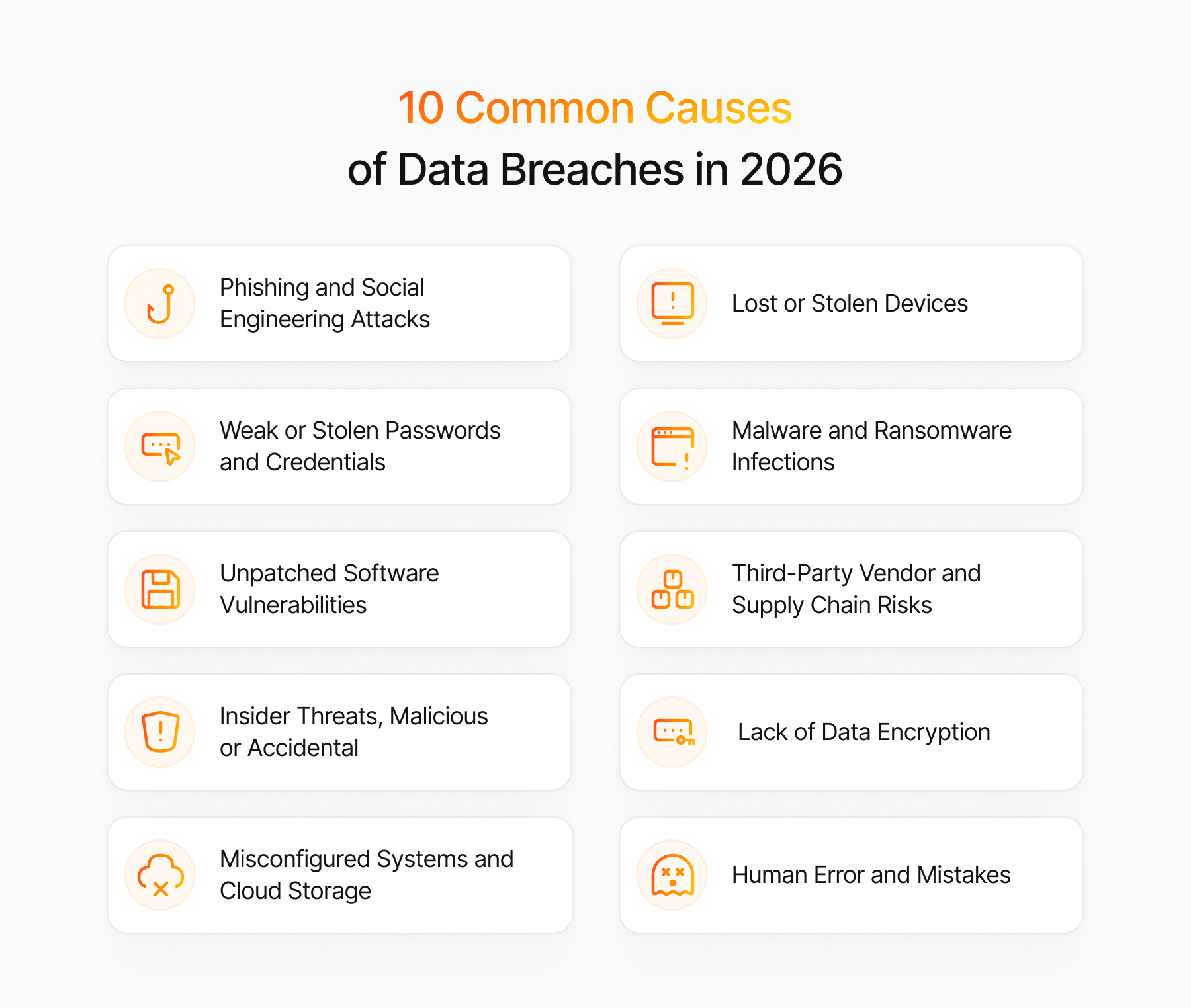
10 Common Causes of Data Breaches in 2026
1. Phishing and Social Engineering Attacks
Phishing remains the number one entry point for attackers, responsible for 16% of breaches per IBM. In 2026, these attacks have become frighteningly convincing, leveraging AI to craft personalized messages that mimic your CEO's writing style or reference recent company events. Attackers target employees with credential harvesting pages that look identical to your actual login portals.
The challenge? Traditional security awareness training isn't enough anymore. Employees receive hundreds of emails daily, and it only takes one moment of distraction or urgency for someone to click a malicious link. We've seen organizations with robust email filtering still fall victim because attackers increasingly use legitimate platforms like Microsoft Teams or Slack to deliver their payloads.
2. Weak or Stolen Passwords and Credentials
Despite years of security education, password-related breaches continue to plague organizations. Employees reuse passwords across multiple services, use easily guessable credentials, or store passwords in insecure locations like spreadsheets or sticky notes.
The problem compounds when you consider shadow IT, those SaaS applications employees sign up for without IT approval. Each new account with a weak password creates another potential entry point. When credentials are stolen from one breach, attackers systematically test them across hundreds of other services through credential stuffing attacks.
3. Unpatched Software Vulnerabilities
Software vulnerabilities are discovered constantly, and attackers move fast to exploit them. The window between vulnerability disclosure and active exploitation has shrunk dramatically. We're talking days, sometimes hours.
The patching challenge is real: you're managing dozens or hundreds of applications across your environment, each with its own update cycle. Some vendors are slower to release patches than others. Meanwhile, your team is juggling competing priorities, and pushing updates can disrupt business operations. But every day a known vulnerability remains unpatched is an open invitation to attackers.
4. Insider Threats, Malicious or Accidental
Insider threats come in two flavors, and both are dangerous. Malicious insiders, disgruntled employees or contractors, intentionally exfiltrate data, often right before leaving the company. They already have legitimate access, making their activities harder to detect.
Accidental insiders are even more common. An employee accidentally shares a sensitive document with the wrong person, misconfigures access permissions, or falls victim to a social engineering attack. These aren't bad actors, they're good people making mistakes under pressure or without proper training.
5. Misconfigured Systems and Cloud Storage
Cloud misconfiguration is the silent killer of data security. An S3 bucket left publicly accessible, overly permissive access controls in Microsoft 365, or a database exposed to the internet without authentication, these mistakes expose massive amounts of data instantly.
The shift to cloud infrastructure has introduced complexity that many IT teams struggle to manage. Default settings aren't always secure, and the shared responsibility model means you're accountable for properly configuring your environment. We've seen organizations discover publicly accessible storage buckets containing customer data months or even years after the initial misconfiguration.
6. Lost or Stolen Devices
Laptops, smartphones, and tablets contain treasure troves of corporate data. When devices are lost or stolen, left in a taxi, taken from a coffee shop, or misplaced during travel, that data becomes immediately vulnerable.
The risk intensifies with remote and hybrid work models. Employees work from various locations, devices move between home and office, and the traditional security perimeter has dissolved. If a device isn't properly encrypted, doesn't have remote wipe capabilities enabled, or allows local data storage of sensitive information, a physical loss becomes a data breach.
7. Malware and Ransomware Infections
Ransomware groups have industrialized their operations, offering ransomware-as-a-service to other criminals. In 2026, ransomware attacks increasingly include data exfiltration, occurring in 96% of attacks per BlackFog, before encryption, a double extortion tactic where attackers threaten to publish your data even if you recover from backups.
Malware delivery methods have diversified beyond email attachments. Attackers compromise legitimate websites, inject malicious code into software supply chains, and exploit vulnerabilities in internet-facing applications. Once inside your network, modern malware moves laterally, escalates privileges, and establishes persistence before revealing itself.
8. Third-Party Vendor and Supply Chain Risks
Your security is only as strong as your weakest vendor. Third-party breaches have become a major attack vector, now involved in 30% of breaches per Verizon's 2025 DBIR, because they provide access to multiple organizations simultaneously. Attackers target vendors with weaker security postures to gain access to their customers' environments.
The challenge is visibility and control. You can implement excellent security practices internally, but if a vendor with access to your systems gets breached, your data is compromised. This includes SaaS providers, managed service providers, contractors, and anyone else with access to your systems or data. According to our analysis of SaaS management patterns, the average organization uses over 100 different SaaS applications, each representing a potential third-party risk.
9. Lack of Data Encryption
Data encryption should be standard practice, but many organizations still have unencrypted data at rest or in transit. When data isn't encrypted, anyone who gains access, whether through a breach, lost device, or insider threat, can read it immediately.
The problem extends beyond just implementing encryption. Key management is complex, performance concerns lead teams to skip encryption for certain systems, and legacy applications may not support modern encryption standards. But when a breach occurs, unencrypted data makes the difference between a serious incident and a catastrophic one.
10. Human Error and Mistakes
Human error underlies many of the other causes on this list, but it deserves its own category because simple mistakes cause so many breaches. An employee sends an email to the wrong recipient, accidentally publishes a private repository as public, or misconfigures a firewall rule.
These aren't security incidents in the traditional sense, no attacker is involved. They're operational mistakes that happen in busy, complex environments where people are juggling multiple responsibilities. The consequences, however, are just as severe as any targeted attack.
Technical Factors Behind Data Breaches
Common Technical Mistakes Leading to Breaches
Technical mistakes often stem from complexity and competing priorities. Organizations accumulate technical debt, legacy systems that can't be easily updated, custom configurations that create security gaps, and interconnected systems where changing one thing breaks another.
Common technical mistakes include:
Inadequate network segmentation: Flat networks allow attackers to move laterally once they gain initial access
Insufficient logging and monitoring: Without proper visibility, breaches go undetected for months
Weak authentication mechanisms: Systems that rely on passwords alone without multi-factor authentication
Exposed management interfaces: Admin panels accessible from the internet without additional protection
Outdated cryptographic protocols: Using deprecated encryption standards that can be broken
The root cause is often resource constraints. Security teams are understaffed, budgets are tight, and business priorities push security updates down the priority list. Technical mistakes aren't usually about ignorance, they're about difficult tradeoffs in resource-constrained environments.
How Vulnerability Exploits Are Used by Attackers
Attackers follow a predictable pattern when exploiting vulnerabilities. First, they scan for exposed systems using automated tools that probe thousands of targets simultaneously. When they find a vulnerable system, they exploit it to gain initial access.
From there, the attack progresses through several stages: reconnaissance (mapping your network and identifying valuable targets), privilege escalation (gaining higher-level access), lateral movement (spreading to other systems), and finally data exfiltration or deployment of ransomware.
Modern exploit frameworks make this process frighteningly easy. Attackers don't need deep technical expertise anymore, they can purchase exploit kits on dark web marketplaces that automate the entire attack chain. The time from vulnerability disclosure to weaponized exploit has shrunk to the point where patching windows are measured in hours, not weeks.
The Role of Human Behavior and Error in Data Breaches
Why Employees Are the Weakest Link
Calling employees the "weakest link" isn't entirely fair, but it reflects reality. Humans are predictable, and attackers exploit that predictability. We respond to authority, urgency, and social pressure. We make mistakes when tired, distracted, or overwhelmed. We trust by default rather than verify.
Attackers understand human psychology better than most security professionals. They craft scenarios that trigger emotional responses, fear of missing a deadline, desire to help a colleague, concern about job security. These emotional triggers bypass rational security thinking.
The challenge is that security often conflicts with productivity. Strict security controls slow people down, create friction, and interfere with getting work done. When security makes work harder, employees find workarounds. They share passwords, disable security features, or use unapproved tools that are easier to work with.
Examples of Human Errors That Cause Data Breaches
Real-world human errors that lead to breaches include:
Sending sensitive data to wrong recipients: Autocomplete suggestions in email clients lead to messages going to unintended recipients
Publishing private information publicly: Developers accidentally commit credentials to public GitHub repositories
Falling for pretexting attacks: Employees provide information to attackers posing as IT support or executives
Misconfiguring access controls: Setting "public" instead of "private" when sharing documents or configuring storage
Using personal devices for work: Accessing corporate data on unmanaged, potentially compromised personal devices
These errors happen constantly across organizations of all sizes. The difference between organizations that experience breaches and those that don't often comes down to having systems that catch these mistakes before they become incidents.
Safeguards and Prevention Strategies for 2026
Essential Security Practices to Prevent Breaches
Preventing breaches requires a layered approach. No single control will protect you, but combining multiple defenses creates resilience:
Implement zero-trust architecture: Verify every access request regardless of source, never assume trust based on network location
Encrypt everything: Data at rest, data in transit, and backup data should all be encrypted with strong algorithms
Implement least privilege access: Users should have only the minimum access required to perform their jobs
Conduct regular security training: Not generic annual training, but ongoing, practical education that reflects current threats
Monitor and log extensively: You need visibility into what's happening across your environment to detect anomalies
From our experience managing SaaS environments, we've found that visibility is the foundation of security. Organizations struggle to secure applications they don't know exist or devices they can't track. As detailed in our approach to SaaS management, maintaining accurate inventory of all applications and their access permissions is critical for preventing breaches.
Emerging Technologies and Tools for Data Protection
New technologies are reshaping data protection in 2026. AI-powered security tools can detect anomalous behavior patterns that humans would miss, identifying potential breaches in progress before significant damage occurs.
Identity Governance Platforms like Josys have become essential for enforcing least privilege access at scale. These platforms give IT teams and MSPs complete visibility into who has access to what across your entire SaaS and application landscape. When a policy is violated, whether it's excessive permissions, inappropriate access, or dormant accounts that should be deprovisioned, you can take immediate action. This strengthens your identity security perimeter by ensuring access rights align with actual job requirements and are continuously monitored for drift. The ability to audit, govern, and remediate access issues from a single platform addresses one of the most common causes of breaches: overly permissive access controls that attackers exploit once they gain initial entry.
Extended Detection and Response (XDR) platforms consolidate security data across multiple sources, endpoints, networks, cloud environments, and applications, providing unified visibility and automated response capabilities. This addresses the alert fatigue problem where security teams are overwhelmed by disconnected warnings from dozens of tools.
Device management platforms have evolved to provide comprehensive visibility and control over all endpoints, regardless of location. Modern solutions enable IT teams to track devices, enforce security policies, manage software updates, and remotely wipe compromised devices, all from a centralized platform.
Conclusion
Data breaches in 2026 stem from a combination of sophisticated attacks and fundamental security gaps. While threats continue to evolve, the core causes remain consistent: weak credentials, unpatched vulnerabilities, human error, and insufficient visibility into your environment. The key to prevention isn't just implementing more security tools, it's building a comprehensive security posture that addresses technical vulnerabilities, human factors, and organizational processes. By understanding these common causes and implementing layered defenses, you can significantly reduce your organization's risk of experiencing a costly data breach.
Take control of your security posture today. As an AI-native identity security and governance platform, Josys gives IT teams and MSPs complete visibility and control over every identity, SaaS application, and device in your environment. Our platform helps you identify shadow IT, enforce security policies, automate access management, and prevent the misconfigurations and access control issues that lead to breaches. Book a demo to see how Josys can strengthen your defenses against the most common causes of data breaches.
Frequently Asked Questions
What are the most effective ways to prevent data breaches?
The most effective breach prevention combines multiple layers of defense. Start with strong authentication using multi-factor authentication across all systems. Implement comprehensive asset and access management so you know exactly what applications and devices exist in your environment and who has access to what. Automate patch management to close vulnerabilities quickly. Encrypt all sensitive data both at rest and in transit. Finally, invest in continuous security training for employees that goes beyond generic awareness to address specific threats your organization faces. No single control prevents all breaches, but this layered approach significantly reduces your risk.
How does device loss contribute to common data breaches?
Lost or stolen devices cause data breaches when they contain unencrypted sensitive information or provide access to corporate systems. A laptop left in an airport or smartphone stolen from a car becomes a breach when the device isn't properly secured. The risk is particularly high with remote work, where devices regularly move between locations and may contain locally cached data. Prevention requires implementing full-disk encryption, enabling remote wipe capabilities, enforcing strong device authentication, and limiting local storage of sensitive data. Device management platforms provide visibility into all endpoints and enable IT teams to quickly respond when devices are reported lost or stolen.
Which HIPAA violations are most commonly linked to data breaches?
The most common HIPAA violations leading to data breaches involve inadequate access controls, lack of encryption, and insufficient risk analysis. Specifically, organizations fail to implement proper authentication mechanisms, allowing unauthorized access to protected health information (PHI). They store or transmit PHI without encryption, making data readable if intercepted or accessed by unauthorized parties. Many breaches also stem from failure to conduct regular risk assessments as required by the HIPAA Security Rule, meaning vulnerabilities go unidentified and unaddressed. Additionally, inadequate business associate agreements and failure to properly manage third-party vendor access frequently result in breaches. Healthcare organizations must implement comprehensive access management, encryption, regular risk assessments, and vendor oversight to maintain HIPAA compliance and prevent breaches.