This site uses third-party website tracking technologies to provide and continually improve our services, and to display advertisements according to users' interests. I agree and may revoke or change my consent at any time with effect for the future.
New regulations are constantly emerging, auditors demand proof of controls you didn't know existed, and your executive team wants assurance that the business won't face penalties or breaches. Meanwhile, you're managing a sprawling SaaS stack, remote teams, and security tools that don't always talk to each other.
Here's the reality: compliance frameworks aren't just bureaucratic checkboxes. When implemented strategically, they become your blueprint for building resilient systems, managing risk, and demonstrating to stakeholders that your organization takes data protection and security seriously. The challenge isn't whether to adopt compliance frameworks, it's knowing which ones matter for your business and how to implement them without drowning your team in documentation.
This guide breaks down the 15 most essential compliance frameworks you need to understand, how they support your business goals, and practical strategies for managing multiple frameworks without burning out your IT team.
What Are Compliance Frameworks and Why Do They Matter?
A compliance framework is a structured set of guidelines, standards, and best practices that organizations follow to meet regulatory requirements, protect sensitive data, and manage operational risks. Think of them as architectural blueprints for your security and governance programs that define what controls you need, how to implement them, and how to prove they're working.
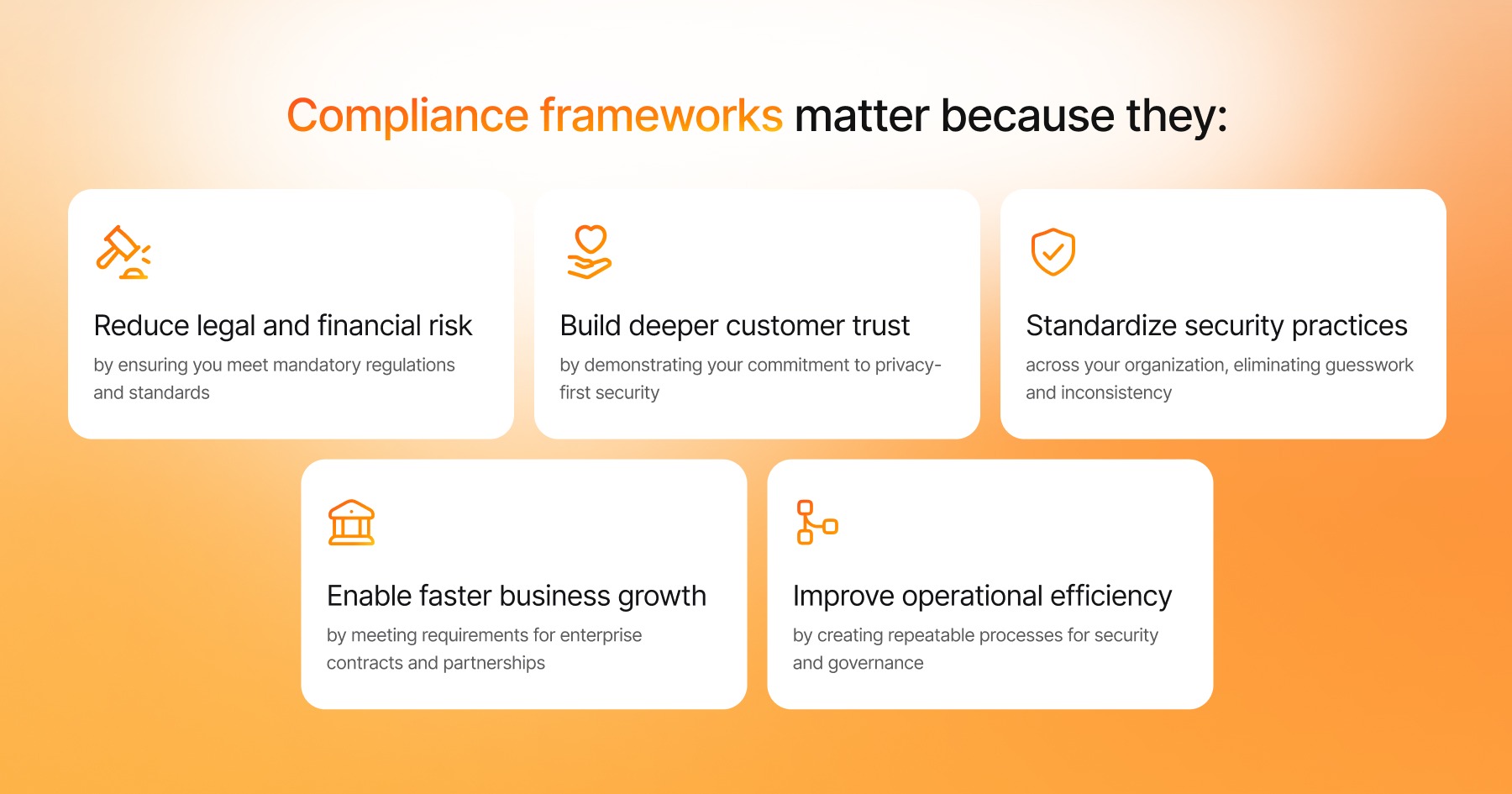
Compliance frameworks matter because they:
Reduce legal and financial risk by ensuring you meet mandatory regulations
Build customer trust by demonstrating your commitment to protecting their data
Standardize security practices across your organization, eliminating guesswork
Enable business growth by meeting requirements for enterprise contracts and partnerships
Improve operational efficiency by creating repeatable processes for security and governance
For IT teams and MSPs, frameworks provide the structure needed to move from reactive firefighting to proactive risk management. Instead of scrambling when an auditor asks for evidence, you have documented processes, automated controls, and clear accountability.
Main Types of Compliance Frameworks
Regulatory Compliance Frameworks
These are legally mandated requirements established by government bodies. Non-compliance can result in significant fines, legal action, or operational restrictions. Examples include GDPR, HIPAA, SOX, and CCPA. If your organization operates in certain jurisdictions or industries, these aren't optional—they're the baseline you must meet to legally conduct business.
Security and Technology Compliance Frameworks
These frameworks focus specifically on information security, cybersecurity controls, and technology risk management. While not always legally required, they're often contractually mandated by enterprise customers or needed for certifications. ISO 27001, SOC 2, NIST CSF, and CIS Controls fall into this category. They provide structured approaches to protecting data, managing vulnerabilities, and demonstrating security maturity.
Industry-Specific Compliance Options
Certain industries have unique compliance requirements based on the sensitivity of their data or their role in critical infrastructure. PCI DSS for payment processing, CMMC for defense contractors, and FedRAMP for cloud providers serving federal agencies are examples. These frameworks address industry-specific threats and regulatory expectations that general frameworks don't fully cover.
Top 15 Essential Compliance Frameworks
General Data Protection Regulation (GDPR)
GDPR is the European Union's comprehensive data protection law that applies to any organization processing personal data of EU residents. It emphasizes data subject rights, consent management, breach notification, and privacy by design. Even if you're not based in Europe, GDPR likely applies if you have European customers or employees. Penalties can reach 4% of global annual revenue, making this one of the most financially significant frameworks—with GDPR fines totaling EUR 1.2 billion in 2024 alone according to DLA Piper.
Health Insurance Portability and Accountability Act (HIPAA)
HIPAA protects sensitive patient health information in the United States. It applies to healthcare providers, health plans, healthcare clearinghouses, and their business associates. HIPAA requires administrative, physical, and technical safeguards to ensure the confidentiality, integrity, and availability of protected health information (PHI). If your SaaS products handle any healthcare data, HIPAA compliance is non-negotiable. Healthcare breaches average $7.42 million in costs and could take 279 days to detect and contain.
Let's look at the case of Nuance/Geisinger. A former Nuance employee accessed Geisinger patient information two days after their termination. Due to incomplete offboarding, HIPAA-sensitive data: names, dates of birth, medical record numbers, dates of service, and facility names were compromised. The result was a $5 million class action lawsuit settlement covering credit monitoring and identity theft protection for victims.
California Consumer Privacy Act (CCPA)
CCPA gives California residents enhanced privacy rights, including the right to know what personal information is collected, the right to delete it, and the right to opt out of its sale. While state-level, CCPA's influence extends nationally because many organizations choose to apply its standards across all U.S. operations rather than create separate processes for California users.
Sarbanes-Oxley Act (SOX)
SOX establishes financial reporting and corporate governance requirements for publicly traded companies. Section 404 specifically requires management to assess and report on internal controls over financial reporting. This means ensuring systems that touch financial data have proper access controls, change management, and audit trails.
Federal Information Security Management Act (FISMA)
FISMA requires federal agencies and their contractors to implement information security programs that protect government information and systems. It mandates risk assessments, security controls based on NIST standards, continuous monitoring, and annual reporting. If you provide services to federal agencies, FISMA compliance is typically required.
Payment Card Industry Data Security Standard (PCI DSS)
PCI DSS applies to any organization that stores, processes, or transmits credit card information. It defines technical and operational requirements for protecting cardholder data, including network segmentation, encryption, access controls, and regular security testing. Non-compliance can result in fines from $5,000 to $100,000 per month from card brands and loss of ability to process payments.
ISO/IEC 27001 Information Security Management
ISO 27001 is an internationally recognized standard for information security management systems (ISMS). It provides a systematic approach to managing sensitive information through risk assessment, control implementation, and continuous improvement. ISO 27001 certification demonstrates to customers and partners that you've implemented comprehensive security practices aligned with global standards.
System and Organization Controls 2 (SOC 2)
SOC 2 is an auditing framework developed by the AICPA that evaluates controls related to security, availability, processing integrity, confidentiality, and privacy. It's become the de facto standard for SaaS companies to demonstrate security maturity to enterprise customers. A SOC 2 Type II report provides independent verification that your controls are both designed effectively and operating consistently over time.
Center for Internet Security (CIS) Controls
CIS Controls are a prioritized set of 18 safeguards designed to defend against the most common cyber attacks. They're organized into Implementation Groups based on organizational size and resources, making them practical for organizations at different maturity levels. The controls focus on specific, actionable security measures rather than broad policy statements.
Control Objectives for Information and Related Technologies (COBIT)
COBIT is a framework for IT governance and management developed by ISACA. It helps organizations align IT strategy with business objectives, manage IT-related risks, and optimize resource utilization. COBIT is particularly valuable for IT teams and MSPs who need to demonstrate how technology investments support business goals and manage enterprise-wide IT risk.
Cybersecurity Maturity Model Certification (CMMC)
CMMC is required for Department of Defense contractors and subcontractors to demonstrate cybersecurity maturity. It combines various security standards into five maturity levels, with requirements increasing based on the sensitivity of the information being protected. If you work with defense contractors, CMMC certification is becoming a contractual requirement.
Josys' autonomous identity governance solution transforms a complex, 110-requirement process into a manageable and sustainable operating model. By automating operationally painful aspects, Josys supports CMMC Level 2 requirements across Access Control, Audit and Accountability, Configuration Management, Identification and Authentication, and Security Assessment.
Microsoft Supplier Security & Privacy Assurance Program (SSPA)
SSPA establishes security and privacy requirements for Microsoft suppliers and vendors. It includes requirements for data protection, security controls, incident response, and subcontractor management. Organizations in Microsoft's supply chain must demonstrate compliance through assessments and documentation.
Federal Risk and Authorization Management Program (FedRAMP)
FedRAMP provides a standardized approach to security assessment, authorization, and continuous monitoring for cloud products and services used by federal agencies. It's based on NIST standards and requires independent third-party assessment. FedRAMP authorization is essential for cloud service providers targeting the federal market.
National Institute of Standards and Technology Cybersecurity Framework (NIST CSF)
NIST CSF provides a flexible, risk-based approach to managing cybersecurity risk. It organizes security activities into five core functions: Identify, Protect, Detect, Respond, and Recover. The framework is widely adopted across industries because it's adaptable to organizations of different sizes and maturity levels, and it aligns well with other frameworks.
National Institute of Standards and Technology Risk Management Framework (NIST RMF)
NIST RMF provides a structured process for integrating security and risk management activities into the system development lifecycle. It includes seven steps: Prepare, Categorize, Select, Implement, Assess, Authorize, and Monitor. RMF is mandatory for federal systems and commonly adopted by organizations seeking a comprehensive risk management approach.
How Compliance Frameworks Support Business Goals
Compliance frameworks aren't just about avoiding penalties—they're strategic tools that enable business growth. Enterprise customers won't sign contracts without evidence of security maturity, typically demonstrated through SOC 2 reports or ISO 27001 certification. Frameworks like GDPR and CCPA build customer trust by showing you respect data privacy. SOX compliance enables public offerings and investor confidence.
From an operational perspective, frameworks reduce inefficiency. Instead of every team member interpreting security requirements differently, frameworks provide standardized processes everyone follows. They create clear accountability, making it obvious who owns which controls and how to demonstrate they're working. This consistency reduces errors, speeds up onboarding, and makes audits far less painful.
Frameworks also improve your security posture by forcing you to address gaps systematically rather than reactively. When you implement NIST CSF or CIS Controls, you're following a prioritized approach based on real-world threat data, not just fixing whatever broke most recently.
How to Decide Which Compliance Frameworks to Adopt
Start with mandatory requirements. Identify which frameworks are legally required based on your industry, location, and the data you handle. If you process EU resident data, GDPR applies. If you handle payment cards, PCI DSS is required. These aren't optional.
Next, consider your customer requirements. Review your enterprise contracts and RFPs to identify which certifications customers demand. SOC 2 is nearly universal for B2B SaaS. ISO 27001 is common for international customers. If you're seeing the same framework requested repeatedly, prioritize it.
Evaluate your risk profile and business strategy. If you're planning to pursue federal contracts, FedRAMP or CMMC should be on your roadmap. If you're expanding internationally, understand regional requirements early. Consider frameworks that align with your maturity level—CIS Controls provide a practical starting point for organizations building their security program, while COBIT is valuable for mature organizations focused on IT governance.
Finally, look for overlap and efficiency. Many frameworks share common control objectives. NIST CSF provides an excellent foundation that maps to numerous other frameworks, making it a strategic first choice that simplifies future compliance efforts.
Common Challenges with Implementing Multiple Frameworks
Overlapping Requirements and Gaps
Different frameworks often address similar control objectives but with varying specificity and evidence requirements. For example, access control requirements appear in GDPR, SOC 2, ISO 27001, and NIST CSF, but each framework defines and measures them slightly differently. This creates confusion about which standard to follow and how to document compliance across multiple frameworks simultaneously. You might also discover gaps where one framework requires controls another doesn't address, forcing you to maintain separate processes.
Resource Constraints and Staff Training
Implementing and maintaining multiple compliance frameworks demands significant time, expertise, and budget. Your team needs to understand each framework's requirements, implement appropriate controls, collect evidence, and prepare for audits—all while maintaining day-to-day operations. Staff turnover compounds this challenge because compliance knowledge walks out the door with departing employees. Training new team members on multiple frameworks is time-consuming and expensive, especially when frameworks use different terminology for similar concepts.
Benefits of Integrating Multiple Compliance Frameworks
Stronger Security Posture
Each framework brings a different perspective on security and risk management. By integrating multiple frameworks, you create defense in depth—layered controls that address threats from multiple angles. NIST CSF provides strategic structure, CIS Controls offer tactical implementation guidance, and SOC 2 ensures operational consistency. The combination creates a more resilient security program than any single framework alone.
Simplified Auditing and Reporting
When you map controls across frameworks and implement them in an integrated way, you can satisfy multiple compliance requirements with the same evidence. A single access control policy, properly designed, can demonstrate compliance with GDPR, SOC 2, and ISO 27001 simultaneously. This reduces documentation burden and makes audits more efficient because you're not maintaining separate control environments for each framework.
Modern Strategies for Streamlining Compliance
Leveraging Automation and Technology
Manual compliance processes don't scale. Spreadsheets, email threads, and shared drives create version control nightmares and make it nearly impossible to demonstrate continuous compliance. Modern IT management platforms automate evidence collection, continuously monitor control effectiveness, and maintain audit trails without manual intervention.
For example, automated SaaS management platforms can continuously verify that only authorized users have access to critical applications, automatically collect evidence of access reviews, and alert you to policy violations in real-time. This transforms compliance from a periodic scramble before audits into a continuous, automated process that requires minimal manual effort.
Maintaining Continuous Improvement
Compliance isn't a one-time project—it's an ongoing program that must evolve with your business, threat landscape, and regulatory environment. Implement regular control testing, not just before audits. Review and update policies quarterly based on lessons learned and business changes. Track metrics that indicate control effectiveness, such as time to remediate vulnerabilities or percentage of employees completing security training.
Create feedback loops where audit findings, security incidents, and near-misses inform control improvements. The goal isn't perfection—it's demonstrable progress and a culture where compliance supports security rather than existing as separate checkbox activities.
How to Simplify and Strengthen Your Compliance Posture with Josys
Managing compliance across multiple frameworks while maintaining visibility into your SaaS stack is exactly what Josys was built to solve. Our platform gives IT teams and MSPs the automated controls and continuous evidence collection needed to satisfy SOC 2, ISO 27001, GDPR, and other frameworks without drowning in manual work.
Takeebbo, a full-stack loyalty solutions platform that helps major retailers turn everyday shoppers into devoted brand fans. The company relied on a diverse SaaS stack to support operations, but quarterly ISO 27001 access reviews involved multi-person checklists and time-intensive QA. With Josys, that process became a single click, and audit overhead dropped significantly by centralizing license and access data with cleaner, more consistent visibility.
Josys automatically discovers all SaaS applications in your environment, continuously monitors who has access to what, and enforces your access policies in real-time. When auditors request evidence of access reviews, you have automatically collected and organized timestamped records. When you need to demonstrate GDPR compliance for data processor agreements, Josys maintains a centralized repository of all vendor contracts and security documentation.
Instead of scrambling to gather evidence before audits, you have continuous, automated documentation of your controls. Instead of manually tracking SaaS subscriptions across departments, you have real-time visibility into your entire application portfolio. This isn't just about passing audits, it's about building a genuinely more secure, better-governed IT environment that scales with your business.
Conclusion
Compliance frameworks provide the structure and credibility your organization needs to manage risk, build customer trust, and enable growth. While implementing multiple frameworks presents real challenges—overlapping requirements, resource constraints, and complexity—strategic integration and modern automation tools make it manageable. The key is understanding which frameworks matter for your business, mapping common controls across frameworks, and leveraging technology to automate evidence collection and continuous monitoring. Done right, compliance becomes a competitive advantage rather than a burden.
Ready to transform your compliance program from manual chaos to automated confidence? Book a demo with Josys today and see how we help IT teams and MSPs maintain continuous compliance across multiple frameworks without adding headcount or drowning in spreadsheets.
Frequently Asked Questions
How do I find official documentation for different compliance frameworks?
Most compliance frameworks provide official documentation through their governing bodies' websites. For NIST frameworks (CSF, RMF), visit csrc.nist.gov. ISO standards are available through iso.org (though full standards require purchase). GDPR text is available through eur-lex.europa.eu. SOC 2 criteria are published by AICPA. CIS Controls are available for free at cisecurity.org. For regulatory frameworks like HIPAA or SOX, the relevant government agency websites (HHS.gov for HIPAA, SEC.gov for SOX) provide official guidance. Many frameworks also have implementation guides, mapping documents, and community resources that provide practical interpretation beyond the official text.
How do compliance frameworks help organizations manage risk?
Compliance frameworks provide structured approaches to identifying, assessing, and mitigating risks systematically rather than reactively. They define specific controls that address known threat vectors based on industry experience and research. By implementing framework controls, you're applying proven risk management practices rather than inventing your own. Frameworks also create accountability by clearly defining who owns which controls and how to measure their effectiveness. They establish baseline security practices that reduce your attack surface and improve your ability to detect and respond to incidents. Perhaps most importantly, frameworks force regular risk assessments and control reviews, ensuring risk management becomes an ongoing process rather than a one-time exercise.
Are there compliance frameworks tailored for the technology sector?
Yes, several frameworks specifically address technology sector needs. SOC 2 was designed for service organizations, particularly SaaS companies, and has become the standard for demonstrating security maturity to enterprise customers. ISO 27001 is technology-agnostic but widely adopted in the tech sector. FedRAMP specifically addresses cloud service providers serving federal agencies. CIS Controls focus on practical cybersecurity measures particularly relevant to technology environments. NIST CSF provides flexible guidance that technology companies can adapt to their specific risk profiles. For organizations in the tech supply chain, frameworks like Microsoft SSPA establish specific requirements for vendors and suppliers.