This site uses third-party website tracking technologies to provide and continually improve our services, and to display advertisements according to users' interests. I agree and may revoke or change my consent at any time with effect for the future.
Every IT director knows the feeling: a new security alert, an untracked SaaS subscription, or a compliance deadline that suddenly feels uncomfortably close. Risk doesn't announce itself politely; it compounds quietly until it demands your attention. That's why risk management frameworks exist: to give you a structured, repeatable way to identify, assess, and control threats before they escalate into real problems.
In this guide, we'll walk through what risk management frameworks are, how they work, and which one might best fit your organization. We'll also share a practical, step-by-step approach tailored for IT and SaaS environments, because generic advice doesn't cut it when you're managing dozens of applications, distributed teams, and evolving compliance requirements.
What Is a Risk Management Framework
A risk management framework is a structured approach to identifying, assessing, prioritizing, and mitigating risks across an organization. Think of it as a playbook that helps you move from reactive firefighting to proactive governance.
Unlike ad hoc risk management, which addresses issues as they arise, a framework provides consistency, accountability, and a shared language across teams. It answers critical questions: What are we protecting? What could go wrong? How likely is it? What controls do we have in place? And most importantly: Are those controls actually working?
For IT directors, frameworks are especially valuable because they bridge technical operations and business strategy. They help you justify security investments, demonstrate compliance, and communicate risk in terms that executives and boards understand.
Core Components of an Effective Risk Management Framework
While different frameworks vary in structure, most share a few foundational elements. Here's what you'll find at the core of any effective approach:
Governance and Culture
Risk management starts at the top. Governance defines who owns risk decisions, how accountability flows, and what your organization's risk appetite looks like. Culture determines whether people actually follow the framework or work around it.
In practice, this means establishing clear roles (who approves new SaaS tools?), setting tone from leadership (does the CEO take security seriously?), and embedding risk awareness into everyday workflows.
Strategy and Objective-Setting
Your risk strategy should align with business objectives. If your company is scaling fast, your risk appetite might tolerate more experimentation with new tools. If you're in a regulated industry, compliance becomes non-negotiable.
This component answers the question: What are we trying to achieve? What risks are we willing to accept? Where do we draw the line?
Risk Assessment and Analysis
This is where you identify threats, evaluate vulnerabilities, and estimate impact. A good risk assessment looks at both likelihood (how probable is this?) and impact (how bad would it be?).
For IT teams, this often means mapping assets (servers, SaaS apps, data stores), identifying threat vectors (phishing, misconfigurations, shadow IT), and assessing existing controls.
Control Design and Implementation
Once you know your risks, you design and deploy controls to mitigate them. Controls can be preventive (access management, encryption), detective (monitoring, logging), or corrective (incident response, backups).
The key is proportionality: high-impact risks warrant robust controls, while lower-priority risks may require only basic safeguards.
Monitoring and Reporting
Risk management isn't a one-time exercise. Continuous monitoring ensures controls remain effective as your environment changes. Regular reporting keeps stakeholders informed and helps you spot trends before they become crises.
This is where automation becomes critical; manual monitoring doesn't scale when you're managing an average of 106 SaaS applications across distributed teams.
Types of Risk Management Frameworks and When to Use Them
Not all frameworks are created equal. Here's a rundown of the most widely adopted models and when they make sense:
1. ISO 31000 Enterprise Standard
ISO 31000 is a broad, principles-based framework applicable across industries. It's flexible, non-prescriptive, and focuses on integrating risk management into organizational processes.
Best for: Organizations seeking a universal approach that can adapt to various risk types, operational, financial, strategic, or compliance-related.
2. COSO Enterprise Risk Management Framework
COSO ERM emphasizes the link between risk and strategy. It's structured around five components (governance, strategy, performance, review, and information) and is widely used in finance and audit functions.
Best for: Public companies, financial services, or any organization prioritizing board-level risk oversight.
3. NIST Cybersecurity Framework and RMF
The NIST Cybersecurity Framework (Identify, Protect, Detect, Respond, Recover) is the top-ranked framework among practitioners for IT security. The NIST Risk Management Framework (RMF) is more prescriptive and often required for U.S. federal systems.
Best for: IT and security teams, especially those in critical infrastructure, healthcare, or government sectors.
4. COBIT IT Governance Model
COBIT bridges IT and business governance. It provides detailed processes for aligning IT with enterprise goals, managing risk, and optimizing resources.
Best for: IT directors balancing governance, compliance, and operational efficiency, particularly in regulated industries.
5. FAIR Quantitative Risk Framework
FAIR (Factor Analysis of Information Risk) quantifies risk in financial terms, helping you calculate loss exposure and prioritize investments.
Best for: Organizations that need to justify security spending with hard numbers and ROI analysis.
6. ITIL Service Lifecycle
ITIL isn't strictly a risk framework, but it includes risk management within IT service design and operations. It's process-driven and integrates well with ITSM tools.
Best for: IT teams already using ITIL for service management who want to embed risk practices into existing workflows.
7. OCTAVE Allegro
OCTAVE Allegro is a lightweight, asset-focused framework designed for smaller teams. It emphasizes practical risk assessment without requiring extensive resources.
Best for: Midsize companies or teams with limited risk management experience looking for a pragmatic starting point.
Step-by-Step Risk Assessment Framework for IT and SaaS
Here's a practical, five-step process tailored for IT environments, especially those managing sprawling SaaS ecosystems:
Step 1: Identify Assets and SaaS Accounts
Start by cataloging everything: servers, endpoints, cloud services, and, critically, SaaS applications. Shadow IT is a major blind spot for most organizations. If you don't know what tools your teams are using, you can't protect them.
Tools like Josys help automate SaaS discovery, surfacing accounts you didn't know existed and mapping them to users, departments, and access levels.
Step 2: Determine Threats and Vulnerabilities
For each asset, identify potential threats, including unauthorized access, data leakage, misconfigurations, vendor breaches, and compliance violations. Then assess vulnerabilities, weak passwords, missing MFA, outdated software, or excessive permissions.
Don't overlook third-party risk. Every SaaS vendor introduces dependencies. If their security fails, so does yours.
Step 3: Evaluate Impact and Likelihood
Rate each risk based on two dimensions: impact (financial loss, reputational damage, regulatory penalties) and likelihood (how probable is this scenario?). Use a simple matrix, high/medium/low, to prioritize.
For example, a ransomware attack on your core CRM might be low likelihood but catastrophic impact. That warrants immediate attention.
Step 4: Prioritise and Treat Risks
You can't eliminate every risk, so decide how to handle each one:
Avoid: Stop the risky activity (e.g., block unapproved SaaS tools)
Transfer: Buy insurance or use contractual protections
Accept: Document and monitor low-priority risks
Focus your resources on high-impact, high-likelihood risks first.
Step 5: Monitor Controls and Iterate
Risk landscapes shift constantly. New SaaS apps get adopted, employees leave, vendors change policies. Set up continuous monitoring to track control effectiveness and trigger alerts when something drifts. Schedule quarterly or biannual reviews to reassess your risk register and adjust priorities.
Enterprise and Financial Risk Management Framework Examples
While this guide focuses on IT and SaaS, it's worth noting that enterprise and financial risk frameworks (like COSO ERM or Basel III for banks) operate on similar principles but emphasize different risk types, market volatility, credit exposure, liquidity, and operational failures.
For IT directors in larger organizations, your risk framework should integrate with enterprise-wide efforts. That means aligning your IT risk register with broader strategic risks and ensuring your reporting feeds into board-level dashboards.
Choosing the Best Risk Framework for Your Organization
Industry and Regulatory Drivers
Start with compliance requirements if you're in healthcare, HIPAA, and HITRUST matter. If you're in finance, SOC 2 and PCI-DSS are non-negotiable. Many industries have preferred frameworks, NIST for critical infrastructure, and ISO 27001 for international operations.
Resource and Skill Constraints
Be honest about your team's capacity. Implementing COSO ERM or NIST RMF requires dedicated resources, expertise, and executive buy-in. If you're a lean IT team, start with something lighter, such as OCTAVE Allegro or a simplified ISO 31000 approach.
Automation and Tooling Compatibility
Manual frameworks don't scale. Look for frameworks that integrate with your existing tools, SIEM, ITSM, identity management, and SaaS management platforms. Automation reduces overhead, improves accuracy, and frees your team to focus on strategic risk decisions, with extensive security automation saving an average of $1.9 million in breach costs.
Common Pitfalls and How to Avoid Them
Overlooking Shadow IT
Shadow IT is the silent killer of risk frameworks. Employees adopt SaaS tools without IT approval, creating blind spots in your risk assessments. Combat this with automated discovery, clear procurement policies, and a culture that encourages transparency over circumvention.
Treat and Forget Control Mindset
Implementing controls isn't the finish line; it's the starting line. Controls degrade, configurations drift, and threats evolve. Build monitoring and review cycles into your framework from day one.
Misaligned Risk Appetite
If your risk appetite isn't clearly defined or communicated, teams will make inconsistent decisions. Document your risk tolerance, share it widely, and revisit it regularly as your business strategy evolves.
How Josys Helps Automate Governance Within Risk Frameworks
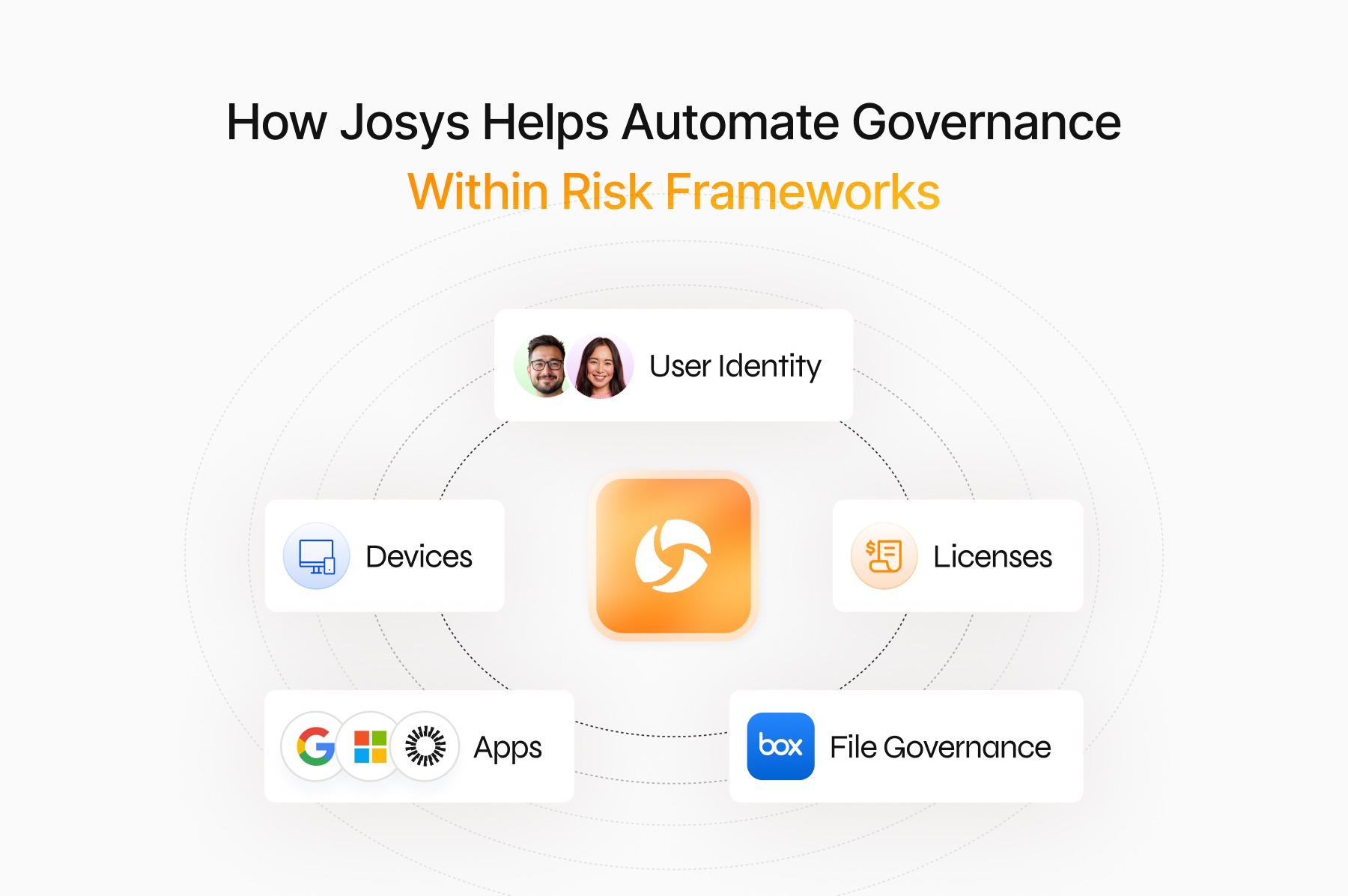
Managing risk manually across dozens of SaaS applications is unsustainable. Josys automates critical governance tasks within your risk framework:
Automated SaaS discovery: Surface shadow IT and maintain an accurate asset inventory
Access control monitoring: Track who has access to what, flag excessive permissions, and enforce least privilege
Compliance reporting: Generate audit-ready reports aligned with ISO 27001, SOC 2, and other standards
Lifecycle management: Automate onboarding, offboarding, and license optimization to reduce risk and waste
By embedding Josys into your risk framework, you shift from reactive firefighting to proactive, data-driven governance.
Putting Risk Frameworks Into Action
Risk management frameworks aren't theoretical exercises; they're practical tools that protect your organization, streamline compliance, and build trust with stakeholders. Start small, choose a framework that fits your context, and focus on continuous improvement.
The most effective frameworks aren't the most complex; they're the ones your team actually uses. Prioritize clarity, automation, and alignment with business goals. And remember: risk management is a journey, not a destination.
Ready to automate governance and take control of your SaaS risk?Book a demo with Josys and see how we help IT teams and MSPs build resilient, scalable risk frameworks without the manual overhead.
FAQ
How long does a typical risk management framework implementation take?
It depends on scope and complexity. A lightweight framework like OCTAVE Allegro can be operational in 4-6 weeks. More comprehensive approaches like NIST RMF or COSO ERM typically take 3-6 months for initial implementation, with ongoing refinement over the first year.
How often should a risk framework be reviewed and updated?
At a minimum, conduct a full review annually. High-risk environments or rapidly changing organizations should review quarterly. Trigger additional reviews after major changes, mergers, new regulations, significant incidents, or technology shifts.
Who should own the risk framework in a midsize company?
Ownership varies, but typically falls to the IT Director, CISO, or Head of Compliance. In smaller organizations, it might be the CFO or COO. What matters most is executive sponsorship and cross-functional collaboration; risk management can't succeed in a silo.
What budget should be allocated for tooling and automation?
Budget varies widely based on organization size and complexity. As a baseline, expect to allocate 5-10% of your overall IT security budget to risk management tooling. For a midsize company, this might range from $20K to $100K annually, including GRC platforms, SaaS management tools, and monitoring solutions. The ROI typically justifies the investment through reduced incidents, faster compliance, and operational efficiency.