This site uses third-party website tracking technologies to provide and continually improve our services, and to display advertisements according to users' interests. I agree and may revoke or change my consent at any time with effect for the future.
Managed Service Providers (MSPs) face mounting pressure to secure client SaaS environments while maintaining compliance and controlling user access across multiple organizations. The complexity multiplies as businesses adopt dozens of cloud applications, each with unique security requirements and access protocols.
A structured playbook approach enables MSPs to standardize their SaaS management processes, reduce security risks, and deliver consistent value to clients at scale. This methodology transforms reactive troubleshooting into proactive governance, protecting client data and ensuring regulatory compliance.
MSPs who master SaaS security management gain significant competitive advantages in client retention and new business acquisition. The ability to demonstrate comprehensive oversight of client cloud environments becomes a key differentiator in an increasingly crowded marketplace.
Key Takeaways
MSPs need standardized processes to manage SaaS security, compliance, and access across multiple client environments
Proper SaaS management tools enable MSPs to deliver proactive governance rather than reactive support
Mastering SaaS oversight provides MSPs with competitive advantages in client acquisition and retention
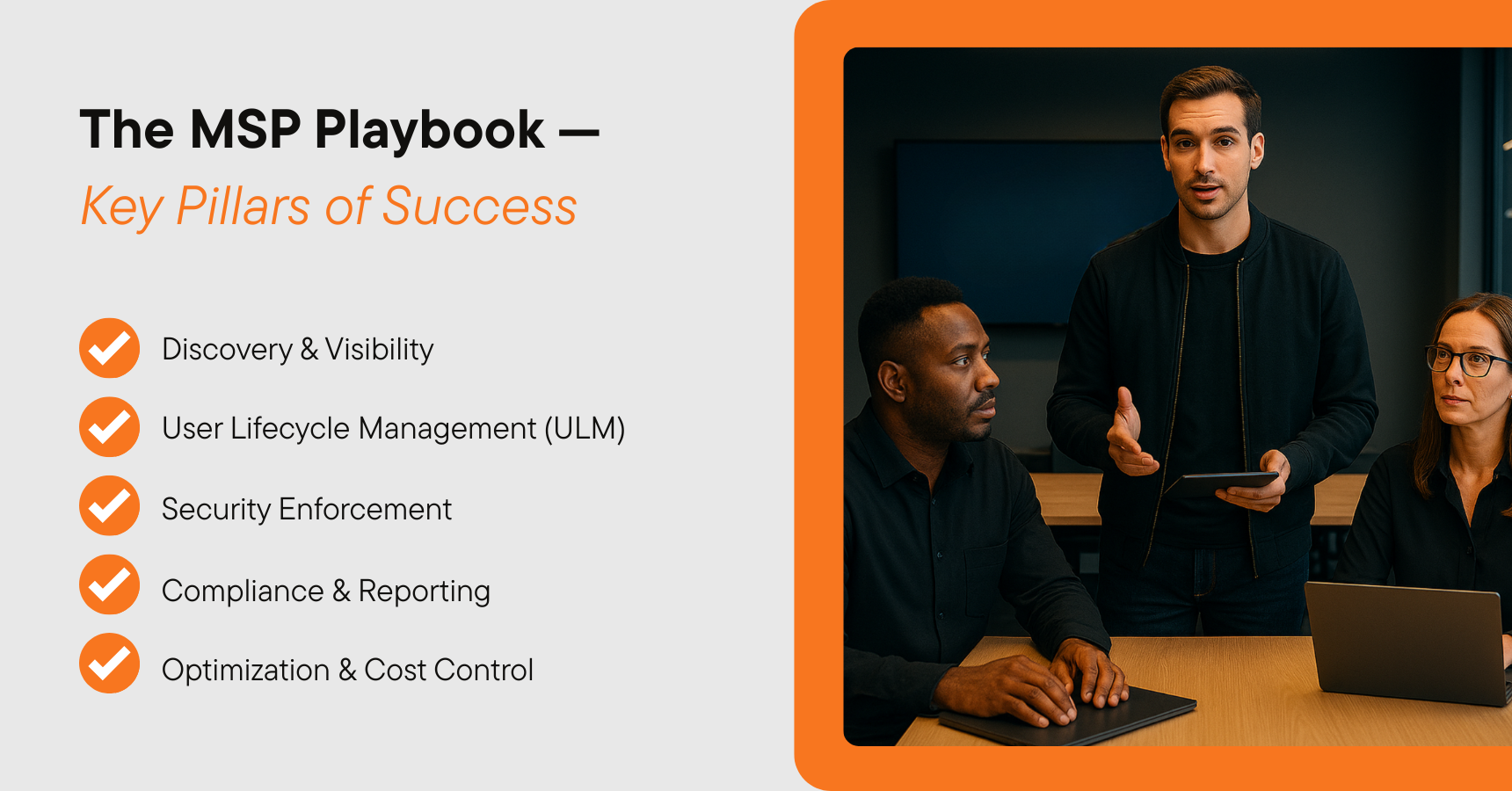
The MSP Playbook — Key Pillars of Success
Successful SaaS security management requires MSPs to master five critical areas that address visibility gaps, user access controls, threat prevention, regulatory requirements, and cost optimization. These pillars work together to create a comprehensive framework for protecting client environments.
Discovery & Visibility
MSPs must first establish complete visibility into their clients' SaaS environments before implementing security measures. Tool sprawl creates blind spots where unauthorized applications operate without oversight or protection.
Automated discovery tools scan networks, email systems, and user activities to identify all SaaS applications in use. These solutions detect shadow IT applications that bypass traditional approval processes.
Key discovery components include:
Network traffic analysis for SaaS connections
Email security integrations for app notifications
Browser extension monitoring
Cloud access security broker (CASB) deployment
Regular visibility assessments help MSPs maintain accurate inventories as clients adopt new applications. This foundation enables proper risk assessment and security policy enforcement across the entire SaaS stack.
User Lifecycle Management (ULM)
Effective user lifecycle management prevents unauthorized access through automated provisioning, deprovisioning, and access reviews. MSPs need centralized systems that manage user identities across multiple client SaaS environments.
Critical ULM processes:
Onboarding: Automated account creation with appropriate permissions
Role changes: Access adjustments based on job function updates
Offboarding: Immediate access revocation upon termination
Identity and access management (IAM) solutions integrate with HR systems to trigger these processes automatically. Multi-factor authentication enforcement adds additional security layers for all user accounts.
Access reviews should occur quarterly to identify dormant accounts and excessive permissions. These regular audits help MSPs demonstrate compliance and reduce security risks from abandoned or over-privileged accounts.
Security Enforcement
Security enforcement requires MSPs to implement consistent policies across all client SaaS applications. Managed service providers must deploy solutions that detect threats, prevent data breaches, and respond to security alerts in real-time.
CASB solutions provide policy enforcement through API connections and inline monitoring. These tools block risky activities like unauthorized file sharing or suspicious login attempts.
Essential security controls:
Data loss prevention (DLP) policies
Anomaly detection for user behavior
Malware scanning for uploaded files
Encryption for sensitive data storage
Security information and event management (SIEM) systems aggregate alerts from multiple SaaS applications. This centralized approach helps MSPs identify patterns and coordinate incident response across client environments.
Compliance & Reporting
Compliance requirements vary by industry, but MSPs must maintain consistent documentation and reporting capabilities. Automated compliance monitoring reduces manual effort while ensuring continuous adherence to regulations.
Common compliance frameworks:
Framework
Key Requirements
Reporting Frequency
SOC 2
Access controls, monitoring
Annual
GDPR
Data privacy, breach notification
Ongoing
HIPAA
Healthcare data protection
Ongoing
PCI DSS
Payment data security
Annual
Backup systems must capture configuration changes, user activities, and security events for audit purposes. MSPs should maintain these records according to each framework's retention requirements.
Automated reporting generates compliance dashboards that track key metrics and identify potential violations. These reports help clients demonstrate compliance during audits and regulatory reviews.
Regular usage analysis identifies unused licenses and redundant applications. MSPs can reallocate these resources or negotiate better pricing with vendors based on actual consumption patterns.
Optimization strategies:
License rightsizing based on user activity
Application consolidation to reduce vendor relationships
Contract negotiation using usage data
Automated provisioning to prevent over-purchasing
Cost reporting should include security tool expenses, compliance costs, and potential savings from optimization efforts. This financial visibility helps clients understand the value of managed SaaS security services.
How Josys Powers the MSP Playbook
Josys delivers comprehensive SaaS management capabilities through automated discovery, centralized control panels, and integrated security enforcement mechanisms. The platform combines real-time monitoring with automated remediation workflows to streamline MSP operations across multiple client environments.
Centralized Multi-Client Management
MSPs access all client environments through a unified dashboard that displays SaaS applications, user access patterns, and security status across their entire portfolio. The platform organizes client data into distinct workspaces while maintaining centralized oversight capabilities.
Client Organization Features:
Separate tenant environments for each client
Unified reporting across all managed accounts
Role-based access controls for MSP team members
Custom branding options for client-facing reports
The system allows MSPs to switch between client environments without multiple logins or authentication processes. Security roles can be configured at both the MSP level and individual client level to ensure appropriate access restrictions.
Dashboard views display critical metrics including application usage, compliance status, and security alerts across all managed clients simultaneously.
Automated Discovery
The platform continuously scans client environments to identify SaaS applications through multiple detection methods including network traffic analysis, browser extension monitoring, and financial transaction tracking. Discovery runs automatically every 24 hours without manual intervention.
Discovery Methods:
Network Traffic Analysis - Identifies applications through DNS queries and HTTPS connections
Browser Monitoring - Captures web-based application usage through browser extensions
Financial Integration - Connects with expense management systems to detect SaaS subscriptions
API Connections - Direct integrations with major SaaS providers for real-time data
New applications appear in the dashboard within hours of first use. The system categorizes applications by risk level, compliance requirements, and business function automatically.
MSPs receive notifications when high-risk applications are discovered in client environments.
One-Click Provisioning/Deprovisioning
User lifecycle management operates through pre-configured workflows that execute across multiple SaaS applications simultaneously. MSPs create user accounts, assign appropriate access levels, and configure security settings through single actions.
Provisioning workflows include automatic assignment of security roles based on job function, department, or custom criteria defined by the MSP. The system maintains templates for common user types to accelerate onboarding processes.
Automated Actions Include:
Account creation across connected applications
License assignment and optimization
Security group membership assignment
Multi-factor authentication enrollment
Deprovisioning removes access from all connected applications within minutes of workflow initiation. The platform provides audit trails showing exactly which access rights were modified or removed.
Automated remediation triggers can be configured to respond to specific events like employee termination or role changes.
Security Enforcement Tools
The platform monitors user behavior, application configurations, and access patterns to identify security violations in real-time. Security policies can be enforced automatically through API connections with SaaS applications.
Enforcement Capabilities:
Password policy enforcement across applications
Multi-factor authentication requirements
Session timeout configurations
IP address restrictions and geofencing
Application-specific security settings
Remediation workflows execute automatically when policy violations are detected. Common remediation actions include forcing password resets, requiring additional authentication steps, or temporarily suspending user accounts.
MSPs configure different security policies for each client based on industry requirements and risk tolerance levels.
Compliance Reporting
Automated compliance reports generate monthly, quarterly, or annual summaries showing adherence to frameworks including SOC 2, GDPR, HIPAA, and ISO 27001. Reports include evidence collection and audit trail documentation.
The system tracks compliance metrics including user access reviews, data retention policies, and security control implementation across all managed SaaS applications. Custom reporting templates allow MSPs to address specific client compliance requirements.
Report Types:
User access certification reports
Data processing activity summaries
Security control effectiveness assessments
Vendor risk assessment documentation
Reports export in multiple formats including PDF, Excel, and CSV for distribution to clients and auditors.
Cost Insights
The platform analyzes SaaS spending patterns, identifies unused licenses, and provides optimization recommendations to reduce client costs. Cost tracking integrates with financial systems to provide accurate spend attribution.
Cost Optimization Features:
Unused license identification and reclamation
Application overlap analysis and consolidation recommendations
Usage-based rightsizing suggestions
Renewal date tracking and negotiation insights
MSPs access detailed cost breakdowns by department, user, and application category. The system calculates potential savings from license optimization and presents ROI projections for proposed changes.
Automated alerts notify MSPs when spending exceeds predefined thresholds or when optimization opportunities are identified.
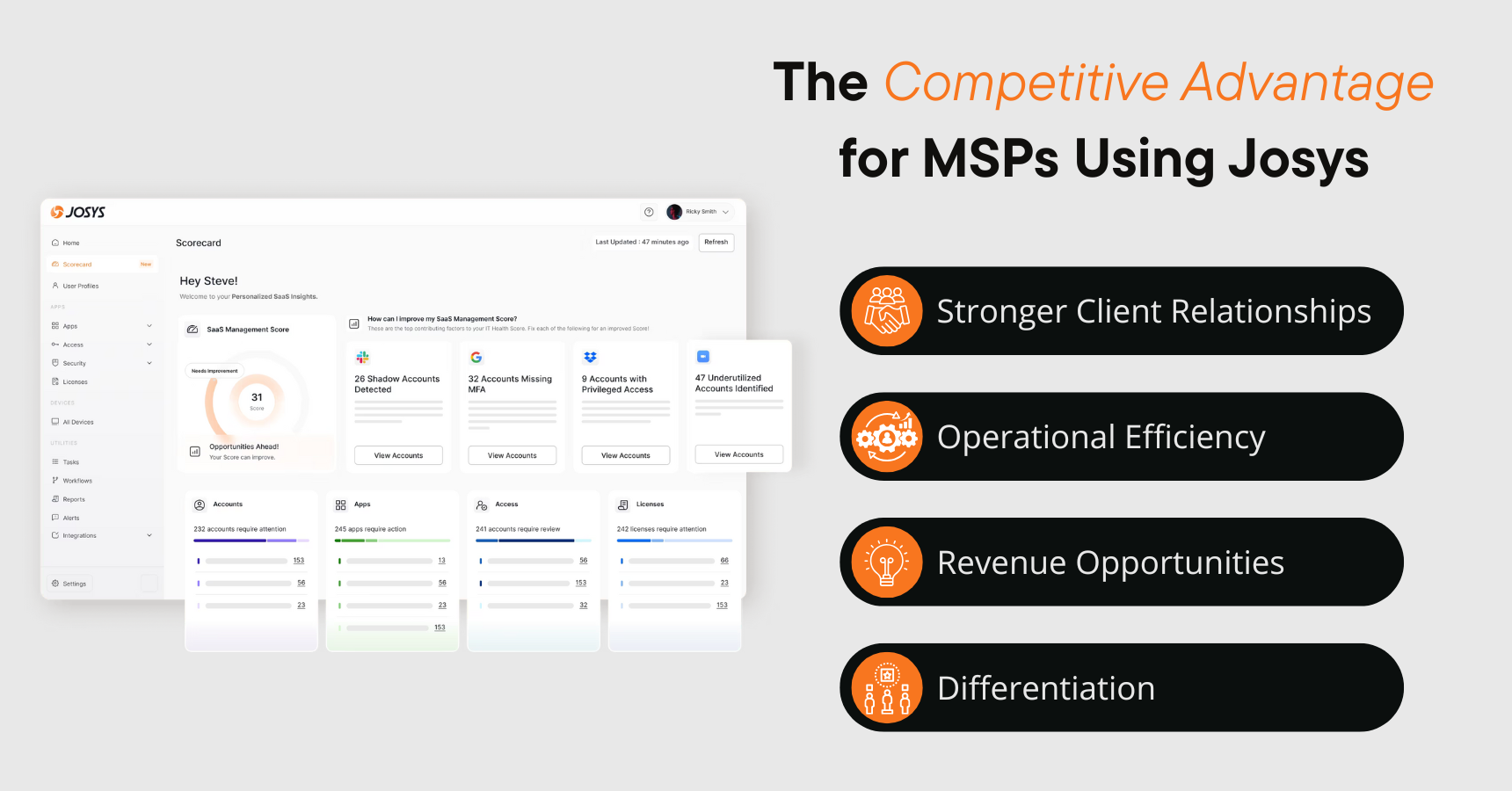
The Competitive Advantage for MSPs Using Josys
MSPs gain measurable business benefits through enhanced service delivery capabilities, improved operational workflows, new revenue streams, and clear market positioning when implementing Josys for SaaS security management.
Stronger Client Relationships
MSPs build deeper trust with clients by delivering proactive security insights rather than reactive problem-solving. Josys provides real-time visibility into SaaS usage patterns and security risks across client environments.
Client retention improves when MSPs can demonstrate concrete security improvements through detailed reporting. The platform generates automated compliance reports that clients can present to auditors and stakeholders.
MSPs position themselves as strategic advisors by identifying unused licenses and security gaps before they become costly problems. This proactive approach shifts conversations from cost centers to value creation.
Key relationship benefits include:
Real-time security dashboards for client meetings
Automated compliance documentation
Proactive risk identification and mitigation
Clear ROI demonstration through license optimization
Operational Efficiency
Service delivery becomes more scalable when MSPs automate routine SaaS management tasks through Josys. Manual user provisioning and license tracking processes that previously required hours can be completed in minutes.
Technicians spend less time on administrative tasks and more time on strategic security initiatives. The platform's automation reduces human error in user access management and license allocation.
MSPs can manage larger client portfolios without proportionally increasing staff. Centralized dashboards provide visibility across all client environments from a single interface.
Revenue Opportunities
MSPs create new recurring revenue streams by offering SaaS security and compliance services as premium add-ons. Clients pay for ongoing monitoring, optimization, and reporting capabilities.
License optimization services generate immediate ROI for clients while creating consulting opportunities for MSPs. Identifying unused licenses often saves clients thousands of dollars monthly.
Compliance-as-a-Service becomes a standalone offering when MSPs can automate audit preparation and ongoing compliance monitoring. Enterprise clients particularly value these services.
Differentiation
MSPs distinguish themselves from competitors by offering comprehensive SaaS visibility that most providers cannot match. Few MSPs provide real-time insights into shadow IT and application security posture.
The platform enables MSPs to support modern hybrid work environments effectively. Remote workforce management becomes a competitive strength rather than a challenge.
Conclusion
MSPs that embrace a structured SaaS security playbook position themselves to thrive in an increasingly complex cloud ecosystem.
By combining discovery, user lifecycle management, security enforcement, compliance, and cost optimization, providers move beyond firefighting and into proactive governance that strengthens client trust.
Josys amplifies this approach with automation, centralized oversight, and actionable insights that streamline operations while reducing risk. The result is not just operational efficiency, but also tangible business outcomes—higher client retention, new revenue streams, and clear competitive differentiation.
In a marketplace where SaaS sprawl and compliance demands are accelerating, MSPs that can prove visibility, control, and measurable ROI will stand apart as strategic partners rather than reactive vendors. The playbook, powered by the right platform, is no longer optional; it is the defining factor that determines whether MSPs remain relevant, resilient, and indispensable to their clients’ digital success.