This site uses third-party website tracking technologies to provide and continually improve our services, and to display advertisements according to users' interests. I agree and may revoke or change my consent at any time with effect for the future.
Identity visibility gaps are structural failures, not individual mistakes. They emerge when the way access is documented diverges from how it actually operates across hundreds of systems, users, and machine identities, and the gap is widening faster than security teams can track it.
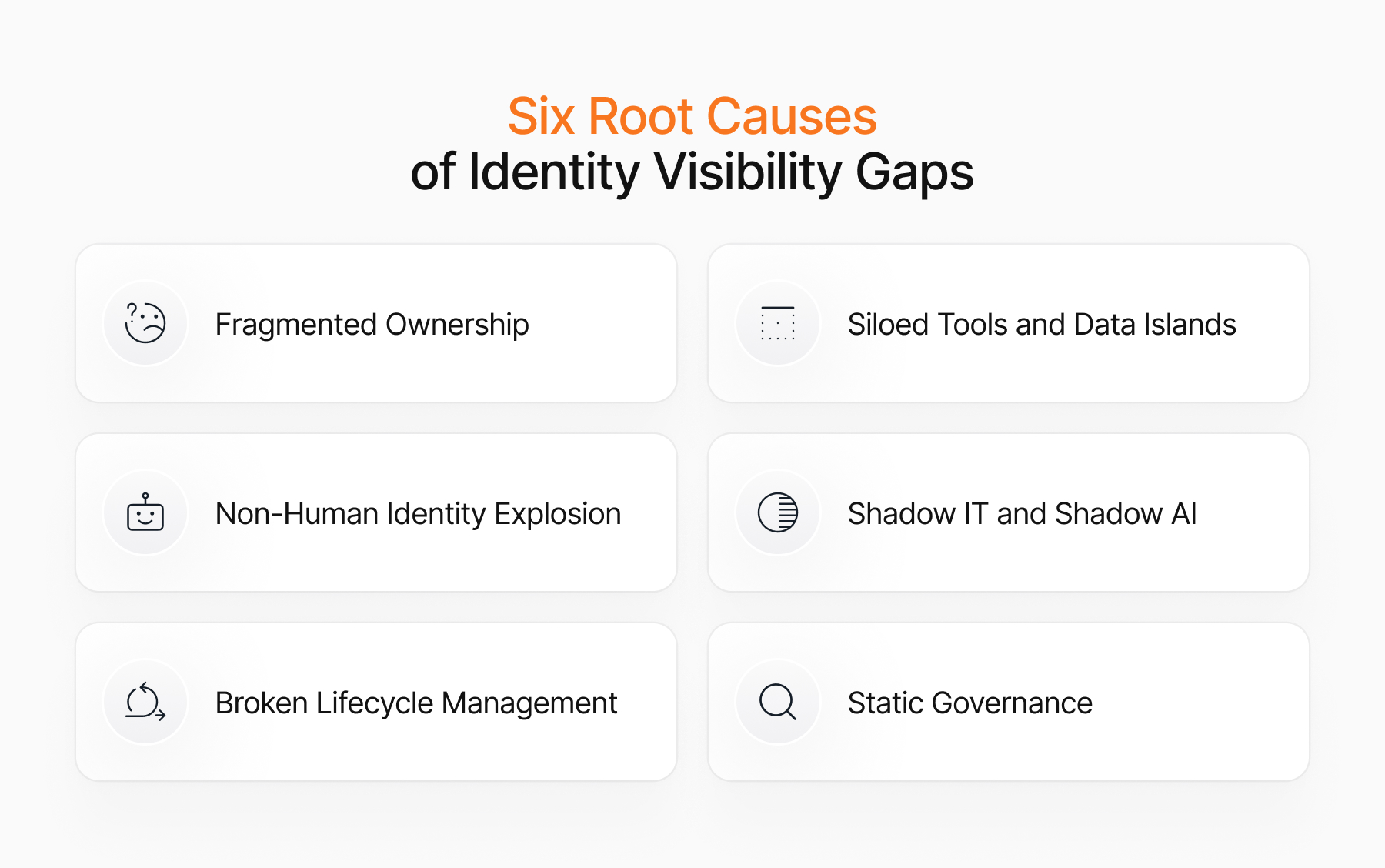
The root causes are predictable: fragmented ownership, siloed tooling, an explosion of non-human identities, shadow IT and shadow AI, broken lifecycle management, and governance models built for an era that no longer exists.
AI adoption is making this worse in a specific, measurable way. According to the Delinea 2026 Identity Security Report, 90% of organizations say they're under pressure to loosen identity controls just to keep pace with AI rollout. That pressure is landing on governance models that were already behind.
This article breaks down the six structural drivers behind identity visibility gaps and what IT leaders can do to start closing them.
Key Takeaways
Identity visibility gaps are the disconnect between how access is documented and how it actually operates day-to-day across your environment.
The root causes are structural: siloed tools, fragmented ownership, and governance models that can't keep pace, not individual negligence.
Non-human identities and AI agents are the fastest-growing blind spot, outnumbering human users 50:1 or more in many organizations.
Static governance cadences like quarterly access reviews were built for slower environments and can't match the speed of cloud and SaaS change.
Closing the gap requires a shift from periodic reviews to continuous identity observability, with policies enforced automatically instead of checked manually.
What Is an Identity Visibility Gap?
An identity visibility gap is the difference between how identities, access, and devices are supposed to work and how they actually work day-to-day. It's not one misconfigured policy or a missed password rotation. It's the accumulated drift between documented access and real access, and it's where identity risk concentrates.
Here's how it plays out: an employee transfers from Finance to Sales. HR updates the role, and the identity provider pushes the change to some connected apps, but not all of them. Old Finance permissions persist, and a forgotten service account tied to a decommissioned integration keeps running with broad access. The organization believes the transition is complete; actual access tells a different story.
Across thousands of SaaS applications, identities, and cloud platforms, no single system holds the complete picture. That gap between intention and reality is the core problem identity governance has to solve.
Six Root Causes of Identity Visibility Gaps
1. Fragmented Ownership Across Teams
No single team can usually answer "who has access to what, and why." HR handles onboarding and offboarding, IT manages devices and infrastructure, security monitors threats, and individual app owners control permissions within their own tools. Each team sees only its slice of the picture, and the gaps form at the handovers between teams, in the spaces no one explicitly owns.
Non-human identities make this worse. Service accounts, API keys, and AI agents often have no designated owner at all; they get created for a project, persist after it ends, and sit in governance no-man's-land. Per Josys/Censuswide research, 33% of organizations have no formal process for AI governance, meaning an entire identity category operates without accountability.
2. Siloed Tools and Data Islands
Even mature identity programs have visibility gaps, because most tooling was built for management, not observability. Enterprises typically run separate systems for identity governance, access management, PAM, and cloud entitlements, each running its own discovery process and rarely sharing data cleanly with the others.
Identity information also lives in HR systems, identity providers, cloud platforms, and SaaS apps simultaneously, each with its own schema and blind spots. More point solutions can widen the gap further: every new tool adds another partial view, so until identity data is consolidated, more tools tend to mean more complexity, not more clarity.
3. The Non-Human Identity Explosion
Non-human identities (NHIs) are the fastest-growing, least-governed category of identity in the enterprise. They outnumber human users by more than 50 to 1 in many organizations, and that ratio is accelerating with AI agent proliferation.
NHIs provision automatically, authenticate through tokens and certificates rather than passwords, and replicate permissions faster than most governance tools can track. AI agents add a further wrinkle: they can request permissions dynamically, and their decision-making is opaque to traditional monitoring. Forty-six percent of organizations already struggle to monitor NHIs, according to the Cloud Security Alliance's 2025 State of SaaS Security Report, and most governance tools were still built around human joiner-mover-leaver workflows that NHIs simply don't follow.
4. Shadow IT and Shadow AI
Every unsanctioned application creates its own identity surface, invisible to centralized IAM, and the scale of unsanctioned adoption is enormous. Gartner predicts that 75% of employees will acquire, modify, or create technology without IT oversight by 2027, up from 41% in 2022.
Shadow AI is the newest, most aggressive variant. Josys/Censuswide research found that 78% of professionals use AI tools daily, but 70% of organizations have moderate to no visibility into that usage. You can't govern what you haven't discovered, and discovery is where most organizations fall short.
5. Broken Lifecycle Management
Identity lifecycle management assumes a clean sequence: provision access on day one, update it with role changes, revoke it on exit. In practice, every stage leaks. Orphaned accounts persist after departures. Unused service accounts accumulate because deleting them might break something. Stale API keys stay active because no one knows which integrations depend on them.
These failures accumulate into identity debt that compounds quietly until a breach or audit exposes the true scope. The problem is sharpest in SaaS, where each app has its own deprovisioning signals: when an employee leaves, the identity provider may revoke SSO, but local accounts inside individual apps can persist indefinitely.
6. Static Governance in a Dynamic Environment
Cloud environments, SaaS applications, and user roles shift constantly, but many organizations still review access on a quarterly or annual cycle. During those reviews, certifiers evaluate hundreds of access decisions in one sitting with limited context, so they tend to approve what looks familiar and flag only obvious anomalies. Organizations take an average of 241 days to identify and contain a breach, according to the IBM Cost of a Data Breach Report. Periodic snapshots can't keep pace with an environment that reinvents itself weekly.
Why These Gaps Are Getting Worse, Not Better
Three trends are compounding the problem at once: AI agent proliferation, as autonomous agents create and modify access in ways traditional tools weren't built to track; multi-cloud complexity, as organizations span AWS, Azure, GCP, and dozens of SaaS platforms; and the shift to SaaS-native architecture, which spreads identity data across hundreds of third-party systems with no central control plane.
As Nathan Archie, VP of US and Global Markets at Josys, puts it: "Solving this problem requires a transition from reactive policies to proactive governance. It demands shifting from surface-level visibility to a deep, contextual understanding of how AI is utilized across the business."
What Is IVIP (Identity Visibility and Intelligence Platforms)?
Identity Visibility and Intelligence Platforms, or IVIP, is the category Gartner introduced in its 2025 Hype Cycle for Digital Identity to describe tools built specifically to close this gap. Rather than another siloed point solution, an IVIP consolidates identity data from directories, IAM and IGA systems, cloud platforms, and SaaS applications into one unified intelligence layer, covering human, machine, and AI identities together. Gartner's own framing gets at why this category exists: different tools perform distinct discovery processes and manage different aspects of identities and entitlements, which is exactly the fragmentation an IVIP is meant to resolve. Its emergence as a named category is a signal that the industry now treats visibility itself as a distinct governance problem, not a byproduct of existing IAM tooling.
How To Start Closing the Gap
Closing an identity visibility gap isn't a tool purchase; it's a governance evolution. Four steps to start:
1. Consolidate identity data into a unified view. Bring identity information for humans, machines, and AI agents together across cloud, SaaS, and on-premises systems into a single source of truth.
2. Automate discovery of every identity and its privileges, including shadow IT and shadow AI. You cannot govern what you haven't found, and discovery has to be continuous, not periodic.
3. Replace calendar-based reviews with continuous, risk-based monitoring that surfaces access anomalies and privilege escalation as they happen, not once a quarter.
4. Move from detection to autonomous enforcement. Define access policy once, enforce it automatically across every application, and route only the higher-stakes decisions to a human. Every identity, including non-human identities and AI agents, needs an accountable owner; an unowned identity is an ungoverned identity.
Josys unifies Access Governance, Identity Security, and License Optimization on one platform, and it's built to go beyond visibility: policies are defined once and enforced autonomously across your stack, so closing the six root causes above doesn't depend on more manual review cycles. Ready to see what your current tools are missing?Request a demo.
FAQs
What is an identity visibility gap?The disconnect between documented access and actual access: the difference between how identities are intended to function and how they actually operate day-to-day.
What is the biggest cause of identity visibility gaps?Fragmented tools and ownership. Each team and system sees only its slice of the picture, so no one has a complete, real-time view.
How do non-human identities create visibility gaps?They outnumber humans 50:1 or more, provision automatically, authenticate differently, and typically lack clear ownership, creating large unmonitored blind spots.
Can access reviews close identity visibility gaps on their own?No. Cloud environments change daily while reviews happen quarterly, leaving months of drift unaddressed between cycles.
What is IVIP?Identity Visibility and Intelligence Platforms (IVIP) is a Gartner-identified category for platforms that consolidate IAM data from directories, tools, and multiple identity domains into one unified intelligence layer.